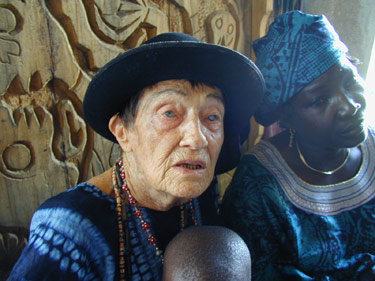
According to innumerable international reports on TV, film and the print-media Susanne Wenger, who was born in the town of Graz, Austria on the 4th of July 1915, became known as the ?white priestess of a sacred riverside deep within Africa?. But she was much more than that, she was one of the most important artists of post war Austria and an outstanding artist in Africa.
Because of her remote position, geographically as well as thematically, sensational stories published in Europe about her exotic and esoteric art after she moved away sometimes created misinterpretations about what she had done in Africa as an artist from Austria. She understood the philosophical message that the gods, the people and the African nature have for every human being and one side of her complex character eventually became Yoruba itself.
She lived in Nigeria for nearly 60 years mostly in the now famous stone house in Ibokun Road, Oshogbo together with her so called ?spiritual family?, where she also had her studio, supporting and supported by her ritually adopted children: chief-priestess Adedoyin Olosun and chief-priest and artist Shangodare G. Ajala. Until her death in Oshogbo at the age of ninety three on January 12th, 2009 she courageously defended all she had given to this Nigerian region and its people.
The Sacred Groves of Oshogbo in Nigeria and the works of art Susanne Wenger created could well be one of the seven miracles of the world. It all started in the 1950?s when Susanne Wenger was called through the Ifa Oracle of the old high-priestess of Oshun, to help to restore the shrine of Idi Baba which by that time was in a sorry state of disrepair. A short time later she started work at Ojubo Oshogbo, the ancient principal temple of the river-goddess Oshun and the main shrine in the groves, which had nearly been destroyed by termites.
Susanne Wenger?s works of art, her huge cement sculptures, daringly artificial and sometimes defying architectural rules, marvellous cult shrines, houses and caves of initiation and endless walls - all depicting the metaphysical - which she created sometimes in cooperation with a group of Yoruba artists, priests and workmen (whom she called ?New Sacred Art?), became eternal reality.
Through the guidance and the dynamics of working with Susanne Wenger many members of this group later became well known artists in their own right such as Adebisi Akanji, Buraihmoh Gbadamoshi, Kasali Akangbe, Ojewale Amoo, Rabiu Abesu, Saka, Alagbede Ajibike Ogun Ni?yi to name just a few.
Chief Shangodare Gbadegesin Ajala became the speaker of the New Sacred Art movement. Adebisi Akanji was Susanne Wenger?s legendary co-builder, who worked with her on most of the monumental cement sculptures that the Sacred Groves are now famous for. Ojewale Amoo was the first to join the team, Saka crafted the spiritual Market Oja Ontotoo while Buraihmoh Gbadamoshi and Kasali Akangbe created most of the sculptures in wood and stone and are now professional sculptors of excellent reputation.
Susanne Wenger?s monumental sculptures and shrines, particularly the Obatala shrine, the Ogboni sculptured shrine ?Iledi Ontotoo?, the statue of Obatala greeting, the statue of Alajere dancing for Oshun, the Chameleon fence of Ebu Iya Mopoo; the monumental figure shrines of Iya Mopoo, the grandiose ?Alajere Transformation Sculpture? and the sky-high figure of Ela became world famous. The lost main entrance to Ojubo Oshogbo, the gate of ?The Flying Tortoise? was one of her major works and might be rebuilt one day. Fifty years after she started her work, the Oshun Groves were declared a UNESCO world heritage site.
And it will be up to the New Sacred Art Movement, founded by Susanne Wenger at first hand, to keep her heritage of sacred art in the Oshun Groves alive.
During all these years, Susanne Wenger not only protected the natural paradise of the Oshun Groves with its mighty trees along the unspoilt bends of the sacred Oshun River, but also one of the most important spiritual centres for the Yoruba culture.
Susanne Wenger, who was a well-known artist before she went to Nigeria, was one of the founding members of the famous international Art Club Vienna in 1946. She produced her first surrealistic drawings in 1943/44 after having had nightmares when the city of Vienna, where she was living at the time, was bombed in World War II. These drawings became important to a group of young Austrian artists who later became famous as ?Vienna School of Fantastic Realism?.
(Her hatred against the Hitler Party was one of the topics of the large exhibition ?Artists in Dark Times? 2001 in Graz, her Austrian hometown).
In 1949 she travelled to Italy, Switzerland and finally to Paris where she met Ulli Beier (who died early 2011), a linguist, whom she married and, surprising all her friends among the Austrian artists, she disappeared to the town of Ibadan in Nigeria.
In 1953, Susanne Wenger published the first ever alphabet book for primary schools in Yoruba.
In 1954 she still had exhibitions in Paris, London, Zurich and Brenda.
<p